
The sounds of Sudani
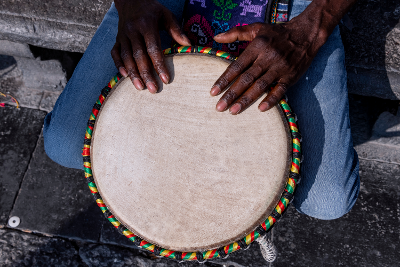
Ahmad, Sahahin, Ridwan and Abdujalil are a group of young people bringing the sounds of their native Sudan to Gorleston-on-Sea, Lowestoft and Norwich, facilitated by the brilliant London-based Sudanese artist Mo Sarrar. Here, both the boys and Mo share their stories with us for Scoop.
Interview with Ahmad, Sahahin, Ridwan and Abdujalil
How do you feel the performance went?
Very beautiful!
Is there a certain song you enjoy performing most?
Everyone has a specific song they love more than the next person. Mambo Sudani - it says a lot about Sudan. The weather, climate, the green trees and the gardens of Sudan. It's a song about how beautiful Sudan is.
Is there a music artist any of you look up to?
Ashraf Sudani ft Iboa.
What music are you currently listening to? Give the readers a music recommendation.
Jameela Jameela - Taha Salman.
Interview with Mo
What's your background in Music, Mo?
I started a long time ago, when I was in my teens. I grew up in an artistic family, my uncle was one of the well known musicians and singers in Sudan.
Really?! What's his name?
His name is Sayed Khalifa.
So your family is musical?
Yes on both sides, and kind of Muslim Sufi.
What is Sufism?
It's about praising Allah and the prophet Muhummad, and it describes doing this in religious song and music. I grew up with that. And then I got into playing drums and this got me to see what I can do more than this. I thought of writing and I found myself writing a few songs and I compose them as well. And one of the songs we sang called Mambo Sudani, it's my uncle's song.
That's their favourite song, I wanted to ask you about that one as they said it tells the story of Sudan beautifully...
Well, whenever I perform somewhere, I sing Mambo Sudani.
What's the story about the song?
Well, the song is - well I guess you know what Mambo is. Mambo is music and dance, like L'italiano Mambo, and it's around the world but Mambo Sudani means the Sudanese Mambo and I changed the beats a little bit. Those beats are easier for the boys so I decided to do them and work out those beats with the boys and then they get used to the drumming and I would change it to the original one. You know Mambo is describing the beauty of people and maybe a beloved person that was described in the song. And you know it's just about the dancing of Sudan and all these kinds of things - the culture if I can say that.
I chose it to sing with the boys for two reasons. It's an upbeat song that everyone would enjoy singing it.
Everyone knows the lyrics because it's a very well-known song in Sudan, and the Middle East as well. And so that would be easier for them to sing it and it happened that they know the whole song which made it way easier. So, I didn't have to teach them the song, we started rehearsing straight away because they know the song and they know how it goes.
When I sing solo, I love the audience to sing with me at some point so that song would be the song that they can start singing straight away. All you have to say is one word which is Mambo...plus I just like the song, I love it.
And it's your Uncle's song! Do the boys know it's your Uncle's song?
They know who sings it, but I never mentioned it was my Uncle. Or maybe I did, I don't know.
That's really cool. I wanted to ask you, how did you choose the songs you wanted to perform? Was it down to being the easiest songs because of the beats, or was there a meaning behind what you choose with your young people?
I let them choose what they want to sing. Mambo Sudani, I chose, but I let them choose what they want to sing. Because I don't want to choose a song that they don't enjoy. I want them to enjoy singing and the more they enjoy it the more they will give their best and they will be creative in what they sing and what they do. So that's my belief to be honest. If you enjoy something you will do your best. So the songs they decided to sing, one of them was "Algannanni". It means "make me crazy" in a good way, not in a bad way. It happens that if not all of them know the lyrics, they know the song well because it's a popular song at home. And they love the idea of singing it, so they sang it.
And the song is by Abu Obaida Hassan who's nickname is Tarzan. He's a genius and he has an incredibly strong voice and when he plays with his song he reminds me of Freddie Mercury. The thing that he plays with, the notes with his voice. Like he gives the strongest thing he has which is why I think they named him Tarzan.
So one of the boys, he liked that song and he wanted to sing it and of course I know the song and I love the idea as well. And we ended up singing it as well. We rehearsed it for a bit, who's going to drum, who's going to sing because we need lots of vocals. We don't need lots of drumming in that song. I asked some of them to just sing, instead of drumming. Or just drumming, because I didn't want vocals in that one. That's why we sang this one and the boys chose it.
There was another couple of songs as well, we didn't sing the other day but we sang in many events and performances. Other songs we sang from other well known singers back home. So that's the idea of choosing things and how we managed to put all this together. It's by asking them what they want to sing and what they enjoy and they just feel free to express what they want and what they like.
How central is music to tethering you to culture?
The thing about music in Sudan, I can tell you that every person in Sudan would never choose something to Music I would say. I mean everyone likes it and it connects everyone. We have more than 570 tribes and each tribe has got their own cultural music. You know that kind of differences in music which connects everyone. So, I take from the West, the east of the country, the central, the south, the north, so I would say everyone would have it (love for Music). Gannani is a song from I think the North of Sudan and if not all of us, most of us from the West, in the group if not all then most of us, so we keep taking from around the country and we do that. So as I said it's the thing that connects everyone and not just in one country. Music is a global language. That everyone can understand and that connects everyone altogether.
And the funny thing that even if you watch Sudanese TV, each programme will have a singer on it. So, whatever the top you will have a guest with a singer or a musician to do a kind of music between the talk. So that's why I would say music is included in everything, in every part of life.
Do you find music different within British Culture?
I don't find it as much as we have it at home. People still love music here but it's not as much as where I came from. I mean wherever I go somewhere, we will have to have music, it doesn't have to be a party, if we are just having dinner with friends, we take our drums and we always have music. It's every time like this, there has to be music there.
The cultural appreciation for music is so different...
It's so different, the musical mindset is not the same.
What's it been like working with these young guys in Norfolk, coming from London?
If I can start from the beginning of how I got to work with the boys. It's since I started the beginning of the year 2024. I got involved by Gary from world wide music, the first time I got involved was by teaching them drums. And I wanted to see what they have more than just playing drums so we started singing and talking about songs and what they like, what they know...
And that time we had other people across different cultures, Vietnamese, Afghani, Persians, all around the world. So I wanted them to share what kind of music they have and we can see what we can come out with. And then after that I got to work with them again in the house, because they found it difficult to come to Norwich in Ramadan. So, we decided to go to the house as they were preparing this big iftar in return for us to come there. We managed to work more in the house and they felt even more free to do more and express more than going to a venue for an hour. We had longer time to work more and express more. And through visiting them in their house it got me to love working with them, although it's like 2 hours on the train from London! Although it was a long journey, I was enjoying it. We were hanging out, singing, drumming and doing all of that. I loved it.


