
The Long Walk to Freedom - The NiCC's Hanan interviews John Kuei
John Kuei, alongside his good friend Giel Malual, completed an incredible 33-day long charity walk from Dungeness all the way to John o'Groats to raise money for new schools in Sudan, their home country
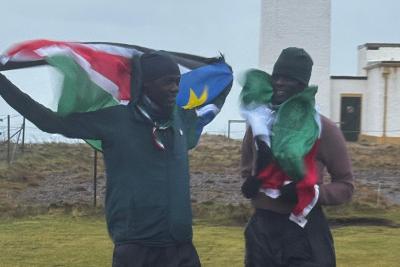
Walking through the harsh British winter, rain, bitter cold, and some days up to 15 hours on their feet, they discovered not only their own strength, but also a powerful community of people who supported them along the way. One of our young people was so inspired by their story that they asked to interview John for our magazine.
Hanan interviews John Kuei & his long walk across the country for Sudan!
Hanan: Yeah. Okay. So, my first question for you is like, what was the thing that inspired you like to be part of what you do now?
John: Thank you for the question. It is a question that I can be clear and answer again. So what made me want to be a part of that journey was as a child who was born in the country that went through difficulty for many years. And when I left the country, I saw the children will not follow the procedure that I went through. And when I saw the kids on social media crying for the food to eat, I asked myself, what can I do to those children? As one of them who went through that situation before when I was there. Those kids, they need help. When someone need help and you have a chance to do that help, just get it. That was the reason make me to do, to be a part of the journey.
Hanan: That's very nice. Okay. So it's like that's the moment that makes you realise that you want to make a difference?
John: Always.
Hanan: Okay. How did your project begin?
John: Well, it began when one of my friend called Giel, who live in London. We have been together since our childhood, and we have a conversation about what we can do. He said we have a plan that people are walking, and people can donate money, and that money can go to those kids to help them to get something like mainly a school, to go to school again. And I said, okay, that will be positive if we do it, but how can we do it? He said, we can start the journey from the bottom of the sea of England to the north of East Scotland. And if we've done that, I believe we will raise something that can build a school to the children who are displaced from Sudan to Chad. We can get them in school. That will make a huge contribution to those kids.
I said, OK, why not? We have to. Because when someone needs help and you have that idea that can bring whatever to their life, you have to do it. I told him that I agreed to do that and I'm very happy to do that with you. He said, okay. And now it's like winter. Why not wait for the summer? I told him that, you know, when you are doing something, if we do it in summer, it would be like going to camping. It would not keep the people feel the pain that we go through. I told him we have to do it in this winter because when the people see us on the snow, cold, rain, they will feel the pain that we are going through. He said, okay, that is actually a good idea. We have to do it.
Our target was £35,000 and the people make it five or six times what we set out to do.
Hanan: That's amazing! While you are doing this charity, what are the obstacles that you have faced and how did you overcome them?
John: Well, for the firt week it was difficult for us to walk because we never done this before and we never went for training. We just thought about it and said, okay, let us do it. For the second day of the walk, it was very, very, very bad for us because we were tired, we were faint, blisters and all those stuff. And we can't even walk. And we slept in the cold like that, when it was rain and so on. It was very difficult for us to handle it. What motivated us was the same as I mentioned before - it was for those kids. When we started from the bottom of the sea of the country, when we arrived in London, it was nearly for us to give up. We said, okay, we are now at home and we are in London. How can we continue to walk on? We can just leave it and go back to the normal life. And we took about 10 or 20 minutes thinking about it. And we came up again, okay, we know that it is a painful walk because when you are walking in the cold and rain and you don't know where you can just live with it, it is difficult. But for those kids, we can put ourselves in their shoes.
Hanan: So, has anyone had a doubt on you because of your age?
John: Good question! For the first day that we decided to walk, I always, if I want to do something, I ask Andy. I text Andy. I told him that we want to walk from south of England to the north of East Scotland. He said, "What, John?!" I said, yes, we want to do it. And he told me, "Okay boy, I believe in what you decided to do. I will be on your back. I will do what I can to support you." That was the one that motivated us, because when a person believes in you and commits to what you are doing, that makes you strong.
Hanan: So I believe you have won a prize, yeah? What was it for?
John: It is an award across all the country. Fundraiser of the Year. It is like the country's young people award of the year.
Hanan: Are you feeling nervous?
John: A bit, yeah. When I don't know something, I feel scared actually.
Hanan: What impact do you hope your efforts are making?
John: The change is to see the children go to school. Because we believe if the country have well‑educated people, the country will move on. A child will have a dream. But if the country have a minority of educated people, or when the country is going through war by war by war, like our country, this happened from our great grandfather. What made me do that was to see those children go to school and build a future. Tomorrow we will look for a better Sudan.
Hanan: How did you feel when you found out you were being considered for the nomination?
John: It was amazing. It was a dream that any child can dream about. I never been nominated before. It was the first time for me in my twenty‑two years. When all the media came to interview us, I felt like I have done a huge contribution in the life of others.
Hanan: If you receive the prize, how would it help your work grow?
John: It will motivate other young people. It will not be me by myself. Other young people will have a chance to do what they believe in. If someone sees John done this, they will say, why not me? That is civilization of the society. It will make young people who came to this country be motivated.
Hanan: What kind of personal qualities should a person have to do this kind of work?
John: For myself, I have done it already. For other people, I advise them: whatever you believe in, you can just get it and do it. Simple. Nothing impossible. When you believe in something and you have that confidence, you have to do it. The problem is fear. If you are between "I can't do it" and "I will do it," that will stop you. But if you put it in your mind and do it, you will achieve it.
Hanan: Okay. It's simple like that. So I can just do it?
John: You can! If you believe in it, you can. Nothing impossible.
Hanan: What has been your like, most proudest moment?
John: My proudest moment was when I speak to the children in Chad, in the refugee camp. When we told them we walked from south of England to north of Scotland to build them a school, they were crying. We told them it wasn't us, it was the people who donated. We did the walk, but the motivation or the achievement on our work, it was the people who committing themselves to put what they can make a day to donate it into that charity work to build you a school. And that what made me to feel like I have done something in the life of the other people.
Hanan: Yeah of course you did! So my last question. Did you see like this recognition as a personal achievement or?
John: Well, from myself, I see it like if I have done something, I know it, I have done it, but for myself, I don't want or I don't need people to tell me that "you have done it." If I've done it for other people, I don't need a thanksgiving, because I know that when I came to this country, I was out of everything, and when I came here, I found hope here. That hope came from other people. Yeah.
Hanan: That's good.
Sufia: You said when you came here, you felt hope from other people. What did that look like?
John: When I came to this country, I didn't go to school before. I didn't speak English. I didn't know about mobile phones. People I didn't know paid my school money, bus ticket, lunch. They felt the pain I went through. Everything I achieved here came through other people.
Hanan: Yeah, I mean, you are brilliant, to be honest. You have done very, like, amazing and unimaginable things with hard experience, I think.
And I think it will get you to be more stronger. You will be in a good place.
John: Thank you.
Sufia: So talk about like the people you met and the community that you met and what that meant to you.
John: You know, when we start the journey, we don't even know that there will be a people who will give us help. We just say that let us do it, we will sleep outside. People saw us on the road walking, they will get off on their cars, stopping their cars and come and ask us, what are you doing? So we explain to them. And that person, they tell us, okay, if we reach where they are living, they will tell us that if you are still walking, we have a friend, they are in front of you, we will call them and they will organize where you will sleep tonight and they will cook for you food, food, and they will ask us, what kind of food do you need? We will say, We need something that is soup, a meat, a lamb, and with some water. Just put them on the pot and you will put them on the fire. And then when we reach that place, we will find the same what we described to that person.
So that tell us that the love and the kindness that we saw to all those communities that we walked through, it was lovely. When you are in the country that have a news and so on, so when you are watching news always, your mind will stick on the something that you have saw on social media. My mind was on the politician. I coined those people on the back on the politician because some of them are saying bad words on the back of the migrant who came to this country. The mentality of the people in this country isn't the same the mentality that politician have. The ideas are different. The love are different. The haters are different. Because what we saw, it was the love from the communities or from the people of this country, because they felt the pain that we are going through. It was something amazing. We are coming out n their houses, give us their fruits, and in the morning, waking up in the morning, we will get a breakfast ready. Their ideas are different. The love is different. If I haven't done this work, I would not know that, to be honest with you.
Hanan: Did you have like any doubt? Because they were so nice to you. And like you said, the way you think of them was not like the right way, like you've been saying. Like, what makes you feel to trust them?
John: No, I have no doubt from British people, to be honest. I have no doubt with them and I would not, even if I saw 10 or 20 or whatever people are saying something, what they are saying I would not count it on other people because I realized that their thinking are different they are not the same. When one person saying something it doesn't mean that the whole country will go through that idea.
Hanan: It's true. And how many hours were you walking in the day?
John: A day that we walked 40 miles, it was like 15.
Hanan: Do you regret it that you came on that pathway? Like, do you regret it?
John: Well, I didn't regret it because it allows to reach where our target was. But it was hard, but we have done it already.
Hanan: Because sometimes the hardest part of your life will be your strength and makes you be like a person who sees things in different way because you already gone through that thing. So yeah, that's why I ask you if you regret it or not.
John: No, we don't. That's a really interesting question.
Hanan: Yeah, the hardest part of your life. It is most of the time.
Sufia: Any other questions Hanan?
Hanan: That's it!
Sufia: John would you like to ask Hanan any questions? We're going to flip it now!
John: What made you interested to interview me?
Hanan: Your story. It feels like a movie! I even told my friends. They didn't believe me until I showed them the newspaper.
Sufia: And now you can show them this article.
Hanan: Yeah, of course.
Sufia: Hanan, you once said you wanted to do something like this walk. Do you think you will one day?
Hanan: Yeah. Actions, whether big or small, will make a change. I'm going to do it one day!
John: Inshallah!
John won the prize for Youth Fundraiser of the Year that weekend in Birmingham, and brought his trophy back to Yarmouth, where he gave a talk at The Place Library.
Massive congratulations to John, and thank you to Hanan for such a thoughtful, brilliant interview. And in sharing this, you've helped amplify John's story, and his country's, even further! In actions and words, that's what change is all about and what you are both working brilliantly to do.


