
Fire risk assessment
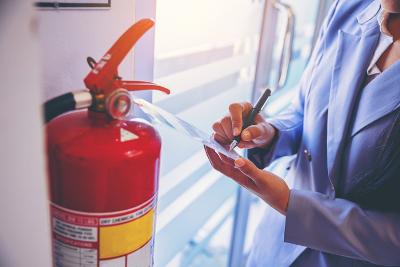
Every business has a legal duty to carry out a fire risk assessment. Visit Choose your business type for guidance on carrying out a fire risk assessment for different types of businesses.
If you have simple premises, you may be able to carry out an assessment yourself using the Government's 5-step checklist, or you can choose a fire risk assessor to carry out the assessment for you.
What is a fire risk assessment?
A fire risk assessment is an 'organised and methodical' assessment of your premises, the activities you carry out there and the risk of fire. It identifies potential fire hazards and what can be done to reduce the risk of harm. It also considers what precautions and arrangements are needed to make sure people are safe if a fire does start.
A fire risk assessment:
- Identifies possible fire hazards and people who may be at risk
- Evaluates the risks and what can be done to remove or reduce them
- Records what was found and done
It is not a one-off assessment. It must be up to date and reviewed regularly, considering any changes to your premises.
Which types of premises need a fire risk assessment?
All 'non-domestic' premises must carry out a fire risk assessment - this means any premises that are not private residential dwellings. These include:
- Workplaces, including of the self employed
- Commercial premises
- Voluntary organisations
- Premises that the public can access
- Common areas in residential buildings with multiple occupants eg the common public areas of a block of flats, but not the flats themselves
- Premises with paying guests, for example, bed and breakfast accommodation, holiday lets and guesthouses
- Houses with multiple occupants (HMOs)
To learn what you need to do for your business type, visit Choose your business type.
Who is responsible for carrying out a fire risk assessment?
Every business must appoint a responsible person (RP). This is the person who is responsible for fire safety in your business and/or building. Part of their role is to carry out and maintain your fire risk assessment. Examples of who is responsible may include an owner, a landlord, an occupier, or anyone else with control of the premises, for example a facilities manager, building manager, or managing agent.
An RP will:
- Carry out - or employ a competent person to carry out - the fire risk assessment
- Regularly review it
- Keep everyone informed
- Make sure there are suitable fire safety measures
- Plan for an emergency
- Ensure people are trained and instructed
You can do the fire risk assessment yourself, particularly if your premises are small or low risk. Visit Choose your business type for more information and links to the relevant government guidance.
However, if on reading the guidance, you have any doubts or reservations about the time, resources, level of understanding, knowledge or any other aspect of carrying out the assessment yourself, you can employ a specialist to do it for you.
Fire risk assessment template
Using the relevant national business guidance document, you can use this template to record your fire risk assessment: Fire Risk Assessment Form (PDF, 51 KB).
5-step checklist
If you are a responsible person (RP) for the simplest of premises and wish to carry out a fire risk assessment yourself, the government has prepared a 5-step checklist for use when doing so.
The checklist consists of five key steps that the RP should undertake. These key steps will look at:
- Fire hazards in your premises
- People in your premises who may be at risk
- The evaluation of fire safety for your premises
- Recording, planning and the training of staff
- Regular review of your assessment
Escape plans, electrical installations, firefighting equipment and signs, heating and more are all included in the checklist, as well as a management list and an action plan.
If you are the RP for a simple premises and wish to conduct your own fire risk assessment, visit Choose your business type for more information.
The 5-step checklist is available in both an accessible and PDF version and can be found on the government website.
Choosing a fire risk assessor
If you wish to appoint a fire risk assessor to carry out your fire risk assessment for you, it is important to check that the person you are employing is competent and can do the job correctly, as the legal duty always remains with you.
Below you will find information about the things you need to consider when finding and appointing a fire risk assessor. You will also find a recap of the types of premises that need a fire risk assessment, who has a legal duty to carry them out and who can do them.
Because the legal duty always remains with you, it is important that you check that the person you are employing to do the assessment is competent and can do the job correctly.
Approach appointing an assessor in the same way that you would approach appointing any supplier for your business.
- Check that the person or company is registered with, or certified by, a professional body or organisation
- Contact the professional body or organisation that they are registered with or certified by, and discuss your needs with them, in order to establish that the assessor you choose is appropriate, sufficiently qualified and competent to carry out an assessment for your type of business
- Check that an assessor has carried out fire risk assessments for businesses and premises like yours before
- Ask for names of previous clients with business/premises similar to yours from whom you can request references
- Ask all and any other questions to satisfy yourself that they are experienced in, and understand your type of business or premises, including if they keep up to date with current practice (for example by attending continuing professional development courses)
- Obtain alternative quotes - make sure they all cover the same scope so you can draw a proper comparison
- Agree work in writing, provide access, keep records and check the assessor has the appropriate insurance
Updating your fire risk assessment
Once your fire risk assessment is completed, it is important that it is regularly reviewed and updated if and where necessary.
By regular monitoring your premises against your fire risk assessment, you can check how effectively the risk of fire is being controlled.
If you feel for any reason that your assessment might no longer be valid - this could be for example, because there has been a change in your premises that affects your fire precautions - it's important to review and if necessary, revise your assessment.
Reasons for reviewing your assessment may include:
- Alterations have been made to your building, including the internal layout
- There have been changes to the furnishings or fixings in your premises
- Your fire precautions such as your fire-detection or alarm systems, sprinklers or ventilation systems have failed
- Your business has started storing, or increased the amount of storage, of hazardous substances
- Your work processes or how you organise them has changed
- There have been changes to stock that you store or display
- The number of people at your premises has increased significantly
- People in your premises have some form of disability
When amending your assessment, it is not necessary to include every small or trivial change. However, if a change introduces new hazards which you consider significant, it is important you take action to keep any risks they may present under control.
If a 'near miss' happens, carry out a re-assessment to ensure that your assessment is still adequate. Remember to identify the cause of such a 'near miss' or incident and review and where necessary revise and amend your fire risk assessment accordingly.
Remember it is not necessary to include every small or trivial change. However, if a change introduces new hazards which you consider significant, it is important you take action to keep any risks they may present under control and where necessary review and update your assessment to reflect this.
Other useful guidance
Depending on your type of business and premises, there may be other helpful guidance available. Visit our Law, guidance and enforcement section where you will find links to helpful information such as:
- The government guide for persons with duties under fire safety legislation
- The National Fire Chiefs Council guidance for specialised housing
- The LACORS information regarding multiple occupation and shared houses and bedsits


